Written by Nimrah Adnan · Reviewed by Aliasgar Khairullah, Chartered Accountant · First published
UAE e-invoicing is the mandatory Electronic Invoicing System (EIS), under which businesses issue invoices as structured XML data rather than PDFs or paper. The Ministry of Finance and the Federal Tax Authority (FTA) run the system. Every invoice passes through an Accredited Service Provider (ASP), with a voluntary pilot from 1 July 2026 and phased mandatory adoption from 1 January 2027.
Key facts
- UAE e-invoices must be structured XML data; PDFs, Word documents, images, scanned copies and emails do not qualify.
- The Ministry of Finance issued Ministerial Decisions 243 and 244 of 2025 on 29 September 2025, setting the framework, scope and phased implementation of e-invoicing.
- The UAE uses a decentralised 5-corner Peppol model in which Accredited Service Providers exchange invoices and report tax data to the FTA.
- Businesses with annual revenue of AED 50 million or more go live on 1 January 2027, and those below AED 50 million by 1 July 2027.
- Businesses below AED 50 million must appoint an Accredited Service Provider by 31 March 2027.
- Business-to-consumer sales are among the published exclusions from UAE e-invoicing.
Vigor Accounting & Taxation is an FTA approved tax agency. We help businesses across the UAE keep in order the VAT records and invoicing data that e-invoicing relies on.
What is e-invoicing in the UAE?
E-invoicing in the UAE is a national system for issuing, sending and receiving invoices as structured data. Accounting systems can read that data without retyping. The Ministry of Finance sets the framework, and the Federal Tax Authority (FTA) receives the invoice data.
The Ministry of Finance publishes the Electronic Invoicing System (EIS) guidance. It states that unstructured formats such as PDF, Word documents, images, scanned copies and emails are not e-invoices. For example, a PDF invoice emailed to a customer does not qualify, even when it shows the correct VAT. Under the Ministry's guidance, e-invoices are created and exchanged as structured XML data.
Key facts
- The system: the Electronic Invoicing System (EIS), with the framework set by the Ministry of Finance and the invoice tax data received by the Federal Tax Authority (FTA).
- Who does what: businesses do not connect to one another directly; each engages an Accredited Service Provider (ASP) accredited by the Ministry of Finance, which validates and exchanges its invoices.
- Format: structured XML built on the PINT AE (Peppol International Invoice UAE) specification and exchanged over the Peppol network, replacing PDF or paper. EDICOM notes that the supplier's ASP transforms documents into the standard PINT AE format where necessary.
- Legal basis: Ministerial Decisions 243 and 244 of 2025, issued by the Ministry of Finance on 29 September 2025.
- Timing: businesses with annual revenue of AED 50 million or more go live on 1 January 2027, and those below AED 50 million by 1 July 2027.
Why is the UAE introducing e-invoicing?
E-invoicing is part of the UAE's move to digitise tax administration and strengthen VAT compliance, in line with international practice.
In practical terms, structured data supports several areas:
- Compliance: invoice data reaches the FTA in a consistent format, so reporting rests on the same record the customer receives.
- Accuracy: accounting systems read the data directly, which reduces manual re-entry.
- Reporting: a single standard format makes invoice information easier to reconcile with VAT records.
What is the e-invoicing model used in the UAE?
The UAE uses a decentralised 5-corner Peppol model, which the Ministry of Finance describes as the Decentralised Continuous Transaction Control and Exchange (DCTCE) model. Under it, structured invoice data moves between businesses through Accredited Service Providers, and the FTA receives the tax data electronically. In this model the FTA sits in the fifth corner and receives the tax data reported by the providers.
The five corners in plain words
The diagram below shows the route of one e-invoice in the 5-corner model, from the supplier's system to the FTA.
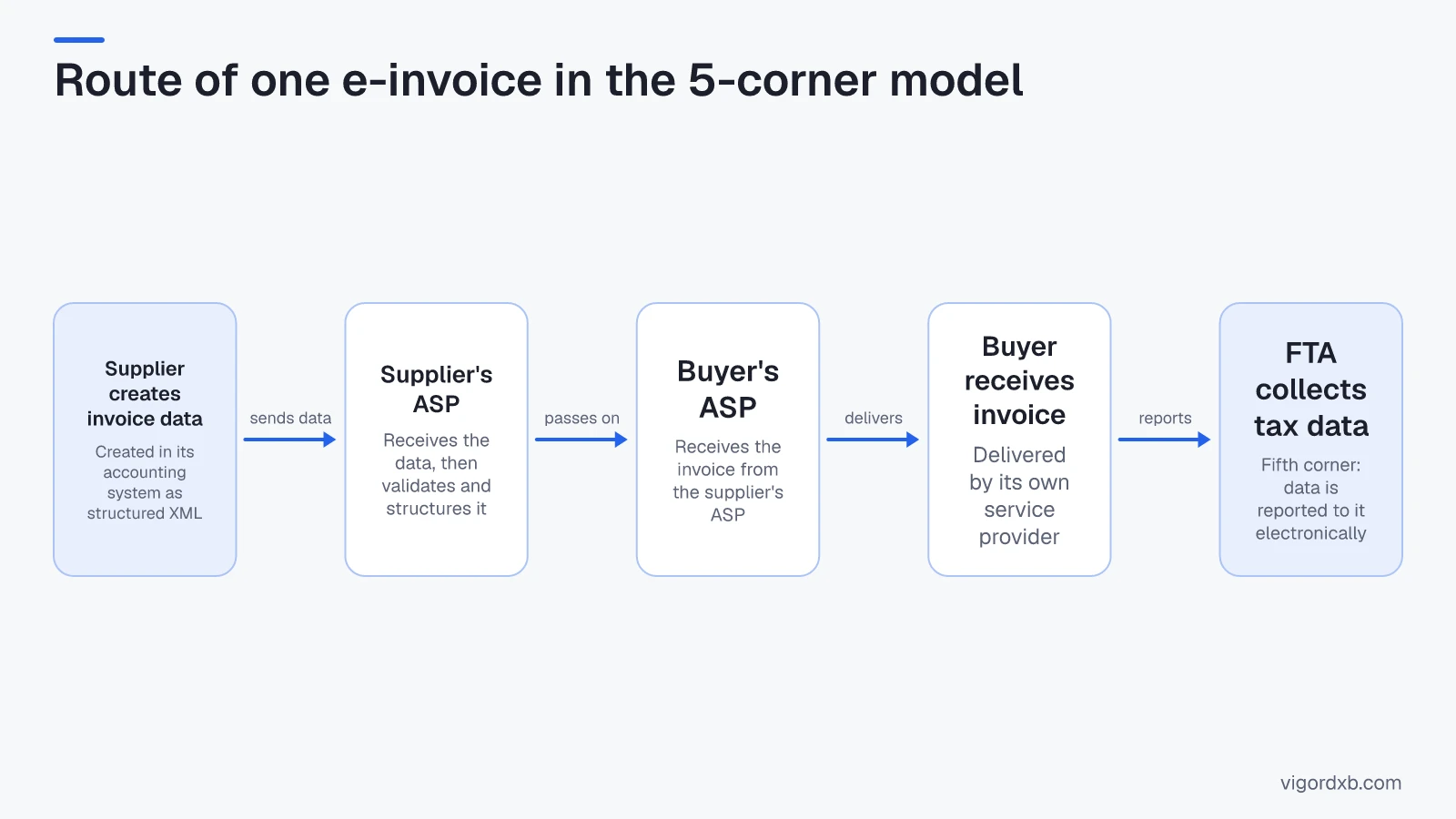
A corner is simply a participant in the exchange. Peppol is the international network standard that allows the corners to exchange structured invoices in a common format. Businesses do not connect to one another directly. Each engages an Accredited Service Provider (ASP), a technology vendor accredited by the Ministry of Finance.
- Corner 1, the supplier: creates the invoice data in its accounting system.
- Corner 2, the supplier's ASP: receives the data, validates and structures it, sends the invoice to the buyer's ASP and reports the required tax data to the FTA.
- Corner 3, the buyer's ASP: receives the invoice from the supplier's ASP and delivers it into the buyer's system, taking part in the same reporting to the FTA.
- Corner 4, the buyer: receives the invoice from its own service provider.
- Corner 5, the FTA: collects the tax data reported by the service providers. The model is decentralised, so the FTA does not sit between the parties; the data is reported to it electronically.
Under the Ministry of Finance guidelines, the ASPs validate and exchange invoices between issuer and receiver and report the data to the FTA, with electronic confirmations for compliance monitoring. As explained in the first section, a PDF or scanned copy does not become an e-invoice by passing through any of these corners.
An everyday example: one invoice from supplier to FTA
Illustrative example: for example, a Dubai office-supplies trader sells printer paper and toner to a hotel group in Abu Dhabi. This is an illustration, not a client case.
Today the trader might email a PDF invoice to the hotel's accounts team. Under the new model, the trader's accounting system instead produces structured invoice data. That data contains the hotel's legal name, tax registration number, the items sold and the VAT charged. The trader's ASP checks that data and passes it to the hotel's ASP. The hotel's ASP then delivers the invoice into the hotel's accounting system, while the FTA receives the tax data.
If the hotel's tax registration number is wrong in the trader's records, the invoice can fail validation. The data must therefore be correct before it leaves your system. Clean customer records, tax registration numbers and invoice details become a matter of preparation rather than correction afterwards.
Is e-invoicing mandatory in UAE, and who must comply?
Yes, e-invoicing is mandatory for in-scope transactions under the UAE Electronic Invoicing System. The obligation is not limited to VAT-registered or domestic companies. According to the Ministry of Finance, the framework, scope and phased implementation are set by Ministerial Decisions 243 and 244 of 2025, both amended in 2026. Your start date depends on your annual revenue, as the timeline later in this article shows.
Transactions in scope
- Business-to-Business (B2B): invoices exchanged between two businesses.
- Business-to-Government (B2G): invoices a business issues to a government entity.
- Government entities: brought in under a later phase, after the first mandatory wave.
- Non-resident or non-VAT-registered entities: included where they carry out a business transaction in the UAE that requires an invoice under UAE legislation.
Exceptions
The published exceptions are listed below. Each is subject to conditions set in the decisions. Confirm the exact wording on the Ministry of Finance e-invoicing portal before treating any transaction as out of scope.
- Sovereign government activities: certain activities carried out by sovereign government entities.
- International passenger transport: including international airline passenger services.
- Air freight: covered by a temporary exemption, not a permanent one.
- Financial services: those that are VAT-exempt or zero-rated.
- Business-to-consumer (B2C) sales: sales to final consumers.
A VAT treatment you already apply does not by itself settle whether an invoice is in scope.
What is the deadline for implementing e-invoicing in the UAE?
The deadline depends on annual revenue. Businesses with AED 50 million or more go live on 1 January 2027. Those below AED 50 million must implement the system by 1 July 2027.
| Phase | Who it applies to | Key date | Reference |
|---|---|---|---|
| Pilot (voluntary) | Selected businesses, and any business opting in, for B2B and B2G invoices | From 1 July 2026 | Ministry of Finance |
| ASP appointment | Annual revenue of AED 50 million or more | By 30 October 2026 (extended from 31 July 2026) | Ministerial Resolution No. (66) of 2026 |
| Mandatory go-live | Annual revenue of AED 50 million or more | 1 January 2027 | Ministerial Decision No. 244 of 2025 |
| ASP appointment | Annual revenue below AED 50 million | By 31 March 2027 | Federal Tax Authority |
| Mandatory go-live | Annual revenue below AED 50 million | By 1 July 2027 | Federal Tax Authority |
| Mandatory go-live | Government entities | By 1 October 2027 | Ministerial Decision No. 244 of 2025 |
The FTA has called on persons subject to e-invoicing to meet these deadlines and avoid administrative penalties. Treat the ASP appointment as your practical first deadline, since choosing a provider and testing data take time. For larger businesses, that date has already passed. Dates can be amended, so confirm them against the current decisions.
What are the requirements for a valid e-invoice in the UAE?
A valid UAE e-invoice is structured XML data, exchanged through an Accredited Service Provider (ASP) and reported electronically to the FTA. PDFs and other unstructured formats do not qualify, as noted in the first section.
Is an e-invoice mandatory in the UAE?
Yes, an e-invoice is mandatory for businesses within scope once their phase applies. The legal basis is Ministerial Decisions 243 and 244 of 2025, covered in the section on who must comply. The Federal Tax Authority has also stated that a person with annual revenues below AED 50 million must appoint an ASP no later than 31 March 2027. That person must then implement the system no later than 1 July 2027.
This requirement applies to companies in the UAE that fall within the published scope, regardless of size or sector. Larger businesses have earlier phases, so confirm your own date in the deadline table above.
What changed in Version 1.1 of the guidelines?
Version 1.1 of the UAE E-Invoicing Guidelines adds clarity on compliance and operational requirements ahead of the pilot phase. According to EDICOM, its most notable addition is a dedicated annex on document retention.
- Taxpayers remain legally responsible for archiving and preserving electronic invoices, even when these services are outsourced to an accredited provider.
- The revised guidance also clarifies advance payment transactions, withholding tax scenarios and taxpayer obligations, so check how it treats any advance payments you invoice before your phase begins.
- The guidelines are available at www.mof.gov.ae/einvoicing, and the Ministry says further updates will be communicated as the programme progresses.
Always open the current version of the guidelines rather than relying on a summary, including ours.
Mandatory fields
The Ministry of Finance publishes a mandatory field requirements document, and the data it asks for can be read in five groups. Please check exact field names against that document, as we do not reproduce the full list here.
- Supplier details: including tax registration information.
- Buyer details: the customer's identifying and registration information.
- Invoice details: the data that identifies the document itself.
- Line details: the goods or services supplied.
- Tax details: VAT charged and invoice totals.
In our experience, incomplete supplier and customer master data is the most likely cause of rejected invoices. We recommend cleaning these records before your phase begins.
Types of e-invoice
The framework recognises three invoice types, each with a distinct purpose.
- Electronic Tax Invoice: issued for a taxable supply.
- Electronic Commercial Invoice: used where a tax invoice is not the applicable document.
- Self-billed Electronic Tax Invoice: raised by the buyer on the supplier's behalf under a self-billing arrangement.
Accreditation is the final requirement. Your ASP should appear on the Ministry of Finance's official list of accredited providers on its e-invoicing portal. Before you issue e-invoices, ensure that your VAT registration is in order; our VAT registration service, listed at the end of this article, explains the process.
What is the role of an Accredited Service Provider in UAE e-invoicing?
An Accredited Service Provider (ASP) is a technology provider accredited by the Ministry of Finance. It onboards businesses, exchanges e-invoices and reports tax data to the FTA. You do not send invoices to the authority yourself. Your ASP validates each one, passes it to the buyer's ASP and reports the tax data on your behalf. The Ministry has updated the status of listed providers to Full Accreditation.
How to choose an ASP
- Confirm the provider appears on the Ministry's official list of Accredited Service Providers.
- Compare it in writing against the Ministry's published considerations for selecting an ASP.
- Check that it works with your accounting or ERP system, and get the scope of services and fees in writing.
- If a provider fails to meet its obligations, a complaint can be submitted through 171 Tawasul, the government's complaints channel.
Which laws and decisions set the UAE e-invoicing rules?
The rules are set by Cabinet and Ministerial Decisions, published with their amendments on the Ministry of Finance e-invoicing portal. The table shows which document answers which question.
| Instrument | What it covers |
|---|---|
| Electronic Invoicing Regulatory Framework | The legal basis for electronic invoicing, electronic accounting and storage of records |
| Ministerial Decisions No. 243 and No. 244 of 2025 (both amended) | Framework, scope and phased implementation of the system, issued on 29 September 2025 |
| Ministerial Resolution No. (64) of 2025 (amended) | Eligibility criteria and accreditation procedure for service providers |
| Ministerial Resolution No. (66) of 2026 | Timeline change, including the ASP appointment date for larger businesses |
| Cabinet Decision No. 173 of 2026 (which replaced No. 106 of 2025); Ministerial Decision No. 168 of 2026 | Further decisions in the framework; the Ministry also lists the rules on violations and administrative penalties |
How should UAE businesses prepare for e-invoicing?
Prepare by confirming which phase applies to you and checking that your systems can produce structured invoice data. Then appoint an ASP well before your deadline. Preparation is mainly a data and systems exercise rather than a paperwork change.
Readiness checklist
Checklist: UAE e-invoicing readiness checklist
- Confirm whether your transactions are in scope, using the Ministry of Finance portal and the Ministerial Decisions it lists.
- Confirm your revenue band. At AED 50 million or more, the ASP appointment date is 30 October 2026 and go-live is 1 January 2027; below AED 50 million, appoint by 31 March 2027 and go live by 1 July 2027.
- List the invoice types you issue and receive, such as tax invoices, commercial invoices and self-billed invoices.
- Ask your software vendor whether your accounting or ERP system can export structured XML data. If you keep your books on VigorBooks, Vigor's own cloud accounting software for UAE businesses, our team confirms how your invoices will reach an Accredited Service Provider before your deadline.
- Shortlist providers from the Ministry of Finance's official list of Accredited Service Providers that support your system.
- Clean customer and supplier master data, including legal names, addresses and tax registration numbers (TRNs), checking every TRN before the first e-invoice leaves your system.
- Reconcile VAT records and invoice numbering so that data sent through an ASP matches your returns.
- Appoint your ASP and link it in EmaraTax by your appointment date: 30 October 2026 or 31 March 2027, depending on your band.
- Run test invoices well before go-live, using the voluntary pilot from 1 July 2026 if you join it, then agree who handles rejections, credit notes and reconciliation.
Common mistakes to avoid
Three mistakes are worth avoiding. The first is treating e-invoicing as a software purchase, when incomplete master data can cause rejections whatever system you choose. The second is assuming a PDF sent through an ASP is enough. The third is leaving ASP selection to the final weeks, with little time left for testing.
How does Vigor Accounting and Taxation help with e-invoicing readiness?
Vigor Accounting & Taxation helps businesses across the UAE align VAT records, invoicing data and bookkeeping with the e-invoicing rules. The aim is accurate structured data before it reaches an ASP. As well as being an FTA approved tax agency, we have been in Business Bay, Dubai since 2017, with 75+ professionals. Clients can also keep their books on VigorBooks, our own cloud accounting software built for UAE VAT and corporate tax.

Our work sits on the accounting side of the process. We check that customer and supplier records, VAT treatment and invoice details in your books are consistent. We also support your VAT return filing so that reported figures match the invoices issued. We do not act as an Accredited Service Provider; that role belongs to providers on the Ministry of Finance list.
Where can you get help with UAE e-invoicing and VAT compliance?
You can get help from a tax agency that keeps your accounting records, VAT filings and invoicing data consistent before your phase begins. Vigor Accounting & Taxation supports businesses across the UAE with:
- Accounting and bookkeeping
- VAT registration
- VAT return filing
- Corporate tax registration
- Corporate tax filing
- Auditing
You can also reach us by phone on +971 56 406 6500.
This article is for general information only and is not financial, tax or investment advice. Please speak to a registered adviser about your own situation.
Investment in securities market are subject to market risks. Read all the related documents carefully before investing.
References
- UAE Electronic Invoicing Guidelines and decisions, Ministry of Finance (linked above)
- Notice on e-invoicing deadlines, Federal Tax Authority (linked above)
- Ministry of Finance press release on the e-invoicing guidelines